
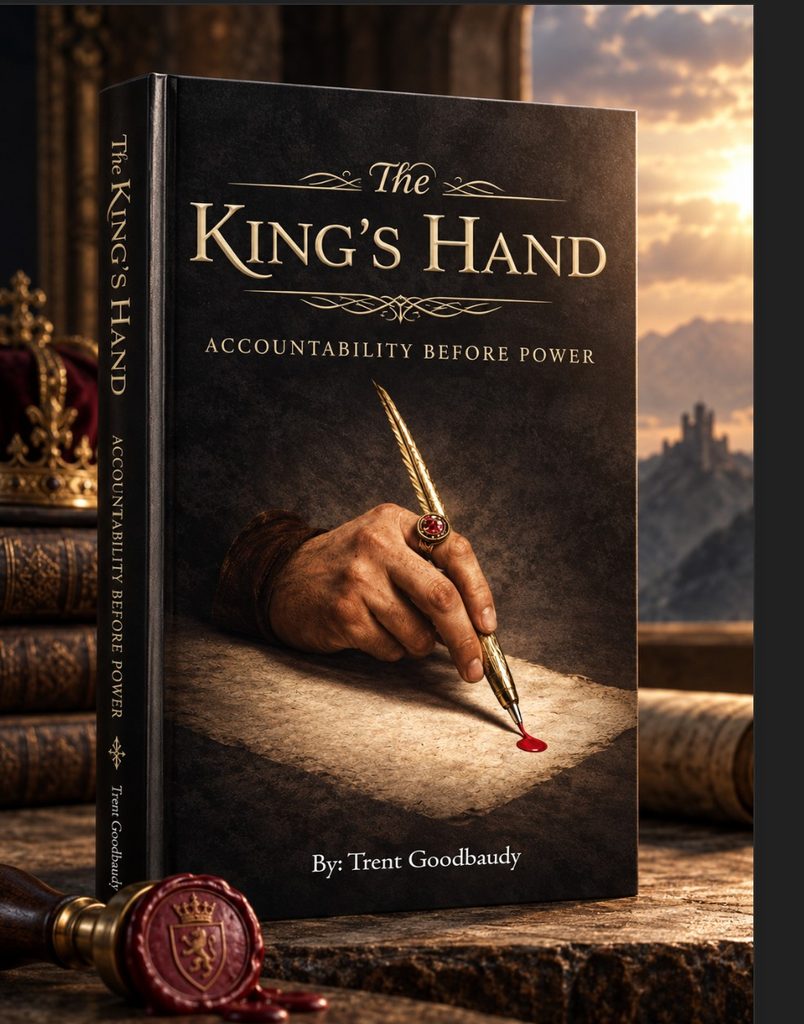
The King’s Hand
Accountability Before Power
Before authority is claimed, before freedom is demanded, and before consequences arrive, there is a quieter question: What did you agree to?
The King’s Hand examines accountability not as morality, punishment, confession, or self-attack, but as the simple ownership of choice. It follows the quiet moments where consent forms, responsibility is avoided, authority becomes performance, and freedom is demanded before its foundation has been built.
About the Book
Power without accountability becomes control. Freedom without ownership becomes blame.
Most conversations about accountability begin after something goes wrong. The King’s Hand begins earlier, at the moment of choice itself.
What happens when you agree because saying no feels uncomfortable? What happens when silence allows a decision to continue? When an expectation is mistaken for an agreement? When authority is claimed before responsibility has been fully owned?
The king in these pages is not a ruler over others. He is the person capable of governing himself. His authority comes neither from title nor permission, but from the ability to stand with what he has chosen without performance, defense, revision, or blame.
Accountability Before Power
- Consent: the moments when agreement forms even without an enthusiastic yes.
- Avoidance: how refusing to engage can still allow an outcome to proceed.
- Blame: why external causes can provide immediate relief while leaving responsibility unresolved.
- Expectation: the difference between what was hoped for and what was actually agreed to.
- Authority: why real authority follows ownership rather than preceding it.
- Control: what happens when power attempts to compensate for missing accountability.
- Consequences: how outcomes change when they stop being interpreted as judgments of identity.
- Freedom: why liberty becomes stable only after responsibility has settled.
The Four Movements
I. Before Power
The moment before authority, consent without clarity, avoidance as participation, and why blame often feels easier than ownership.
II. The Nature of Accountability
Responsibility without punishment, ownership without an audience, the difference between expectation and agreement, and the accumulated cost of unexamined yeses.
III. The King Without a Crown
Internal authority without permission, standing where you stand without revision, power that does not need display, and why control fails where accountability works.
IV. After the Signature
Living with what you chose, meeting consequences without personalization, and discovering why freedom arrives as a result of ownership rather than a demand for escape.
The Attestations
Throughout the book, brief Attestations interrupt the argument.
They are not lessons, instructions, or scenarios to solve. An attestation simply records the moment when consent, avoidance, agreement, or ownership becomes visible.
He agreed quickly so the conversation would end.
He said later that he was pressured.
The terms were available.
He did not read them.
Nothing was hidden.
They leave very little room for explanation. That is intentional. Once the moment of choice can be seen clearly, the story surrounding it becomes less necessary.
Accountability Without Punishment
Accountability is not punishment. It is accuracy.
Responsibility becomes threatening when it is confused with shame, humiliation, or worth. When those are removed, ownership becomes much simpler: this happened, this was chosen, this part was mine.
No confession is required. No audience is necessary. No performance of regret makes the ownership more complete. The book separates responsibility from self-attack and asks what remains when nothing has to be defended.
The King Without a Crown
Internal authority does not come from permission. It comes from ownership.
Once responsibility is accurately held, authority changes character. It becomes quieter. It needs less explanation, less validation, less control, and less performance.
The person who governs himself does not need to govern everyone else. Disagreement can remain disagreement. Boundaries can stand without persuasion. Power no longer has to prove that it is power.
Why Freedom Arrives Late
Freedom pursued before accountability is settled has to be defended constantly.
The King’s Hand follows a different sequence. Clarity first. Ownership next. Authority after that. Freedom arrives later, not because someone granted it, but because the internal argument has ended.
Liberty, in this framing, is not escape from consequence. It is the absence of distortion around consequence. Nothing necessarily disappears outside you. Something stops fighting inside you.
What This Book Is Not
- It is not a legal guide.
- It is not a moral code.
- It is not a system for assigning blame.
- It is not a demand for confession or public accountability.
- It is not a framework for controlling other people.
- It is not a collection of steps, techniques, or rules for becoming more powerful.
The book intentionally remains earlier than instruction, law, enforcement, and strategy. It is concerned with the quieter point at which a choice became yours.
Who This Book Is For
This book is for readers interested in where personal authority actually begins.
It may resonate with people tired of blame without resolution, responsibility performed for an audience, authority that depends on control, or freedom that must constantly be defended.
It is also for readers willing to examine the small agreements, silences, expectations, and unexamined yeses that quietly shape much larger parts of life.
Book Details
Title: The King’s Hand
Subtitle: Accountability Before Power
Author: Trent Goodbaudy
Series: The Liberty Truth Series
ISBN-13: 9798279217496
Frequently Asked Questions
What is The King’s Hand about?
It examines accountability as ownership rather than punishment. The book traces the relationship between consent, responsibility, authority, control, consequence, and freedom, beginning with the moments where choices and agreements are formed.
Is this a book about political power or kings?
No. The king is a metaphor for self-governance. The central question is not how to gain authority over other people, but what authority looks like when a person can stand honestly with his or her own choices.
Does accountability mean blaming yourself?
No. The book explicitly separates accountability from punishment, shame, confession, and self-attack. Accountability is treated as accuracy: recognizing what belonged to you without adding moral judgment to it.
What are the Attestations?
Attestations are brief records placed throughout the book. They mark moments when consent, avoidance, agreement, responsibility, or ownership becomes visible without explaining what the reader should think about it.
Why does the book say freedom arrives late?
Because the book treats stable freedom as an outcome of clarity and ownership rather than an escape from obligation. When agreements and consequences are accurately owned, freedom no longer has to be constantly asserted or defended.
Does the book provide steps or advice?
No. That absence is deliberate. The King’s Hand avoids instruction, legal interpretation, techniques, and prescriptive frameworks because its focus is recognition rather than compliance.
The Hand Remains
When excuses disappear, responsibility does not. What changes is the amount of energy required to defend against it. Accountability settles. Authority becomes quiet. And freedom no longer has to be claimed.