
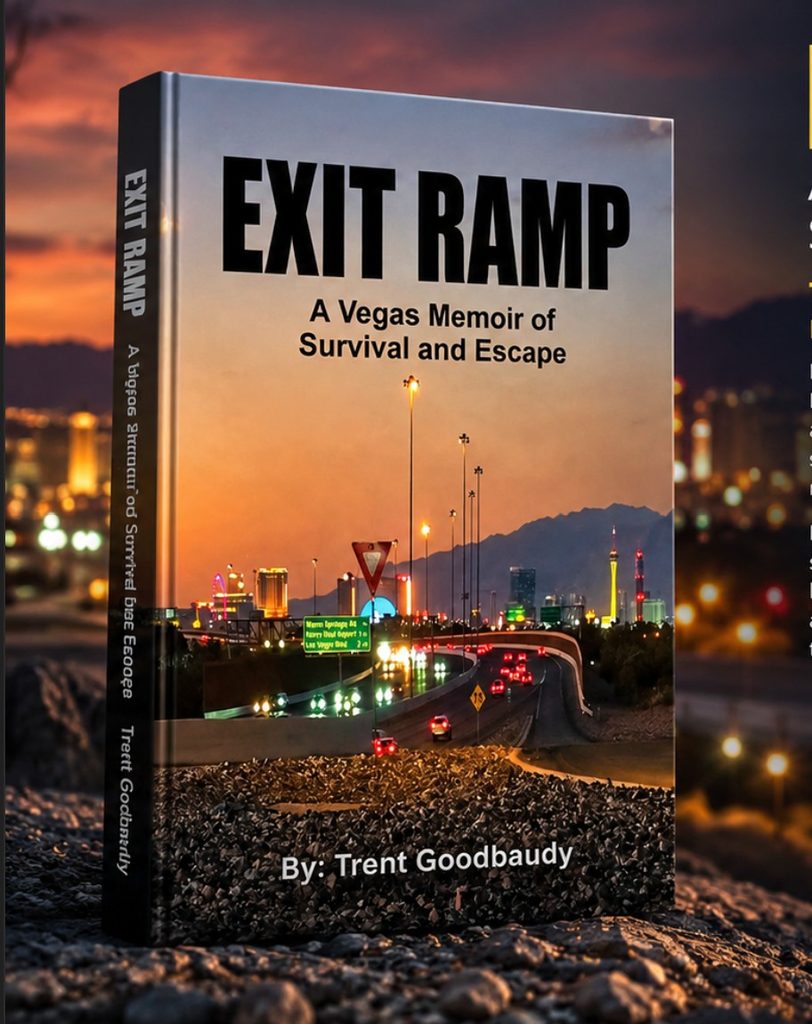
EXIT RAMP
A Vegas Memoir of Survival and Escape
Las Vegas never stops moving. This is what the city looks like from the driver’s seat when you stay inside that motion long enough to discover what it costs.
EXIT RAMP is a firsthand memoir of driving Uber through Las Vegas during one of the most turbulent periods of Trent Goodbaudy’s life. It begins with the strange, funny, dangerous, and deeply human stories that happen between destinations, then follows the road into exhaustion, illness, instability, collapse, and the moment when survival finally required leaving.
About the Book
Tourists see neon, fountains, casinos, shows, and fantasy. Drivers see loading docks, back entrances, impossible traffic, exhausted workers, dangerous streets, late-night confessions, and the people behind the masks.
EXIT RAMP tells that other story of Las Vegas. It follows the city mile by mile through the eyes of an Uber driver who learned its rhythms by necessity: airport runs, casino pickups, surge zones, hidden roads, unpredictable passengers, violence that appears without warning, and unexpected moments of kindness between strangers.
But the book does not stay a collection of rides. The job becomes the setting for a larger story about constant motion, burnout, physical trauma, neurological decline, financial instability, sleeping in a Tesla, and the slow realization that continuing is not always the same thing as living.
At its center is a question that reaches far beyond rideshare work: How do you know when the life you are surviving has become the life you need to leave?
You’ll Ride Through
- The hidden rules Uber drivers learn about navigating Las Vegas.
- Late-night airport runs, casino pickups, surge zones, and traffic patterns tourists never see.
- The “Milk Girl on Utah Avenue,” whose desperate request only makes sense once the rest of her story is revealed.
- Gunshots on Tropicana and the eerie normalcy that follows.
- A violent underground scene at Caesars Palace during the hour when Vegas becomes something else entirely.
- The “Inspirada Giant,” a passenger so intoxicated that simply getting him home becomes an adventure.
- Vomiting passengers, dangerous roads, strange encounters, and the everyday hazards of rideshare work.
- The Tesla period, exhaustion, neurological symptoms, and the point where the work stopped being sustainable.
- The call home and the decision to finally leave Las Vegas.
More Than a Memoir
The Real Las Vegas
The city behind the Strip: workers, alleys, pickup zones, loading areas, hidden routes, exhausted night crews, and the machinery underneath the spectacle.
Human Behavior at 3 A.M.
Passengers confess, fight, flirt, grieve, panic, overshare, and sometimes reveal more to a stranger behind the wheel than they would to people they know.
The Cost of Constant Motion
The memoir tracks what happens when work, survival, sleep loss, stress, illness, and financial pressure begin stacking faster than the body can recover.
The Uber Driver Survival Guide
The appendices expand beyond story into lessons about burnout, mental survival, street awareness, rideshare strategy, passenger psychology, and recognizing when it is time to stop.
Vegas Street Survival
The book includes practical observations about routes, scams, danger patterns, fatigue, distractions, and the street-level instincts that come from living inside the city’s overnight rhythm.
Finding the Exit
The final arc is not about conquering Las Vegas. It is about recognizing that leaving can be an act of survival, and that going far down a road does not obligate you to keep following it.
What Vegas Taught Me
- Survival is not the same thing as living.
- Rest is not a luxury when the body is already carrying too much.
- Breakdown can happen slowly, through hundreds of small compromises rather than one dramatic collapse.
- Even in a city built on taking, small acts of human kindness still matter.
- Asking for help can be the beginning of a different story.
- You do not have to keep going just because you have already gone far.
- There is always an exit ramp.
Who This Book Is For
EXIT RAMP is for readers who want the Las Vegas that exists behind the tourism ads.
It is for rideshare drivers, gig workers, night-shift workers, and anyone who understands what it is like to keep working because stopping does not feel economically possible.
It is also for readers who have experienced burnout, illness, instability, or a period when momentum itself became a trap.
And it is for anyone who has ever wondered whether walking away from something might be less a failure than the first real decision to survive it.
Book Details
Title: EXIT RAMP
Subtitle: A Vegas Memoir of Survival and Escape
Author: Trent Goodbaudy
Series: The Liberty Truth Series
Publication date: December 20, 2025
Kindle print length: 207 pages
Paperback ISBN-13: 9798279142729
Frequently Asked Questions
Is EXIT RAMP a true story?
Yes. It is a memoir built from firsthand experiences driving Uber in Las Vegas, along with the personal circumstances that unfolded during that period.
Is the book mainly about Uber?
Uber is the lens through which much of the story is told, but the larger subject is survival inside constant motion. The book moves from rideshare stories into burnout, illness, instability, recovery, and eventually leaving Las Vegas.
Does the book include practical information for drivers?
Yes. The appendices include material on Uber driver survival, passenger psychology, gig-worker mental survival, Vegas street survival, navigation, the city’s operating rhythms, and recognizing when it is time to stop.
Is this a Las Vegas travel guide?
Not in the conventional sense. It contains insider knowledge about the city, but its perspective is street-level and operational rather than tourist-oriented. It is the Las Vegas seen from pickup lanes, back roads, garages, casino service areas, and thousands of miles behind the wheel.
Why is the book called EXIT RAMP?
Because the memoir ultimately becomes a story about recognizing when momentum has turned into a trap. The most important road in the book is the road away from a life that can no longer be survived by simply pushing harder.
You Don’t Have to Keep Going Just Because You’ve Gone So Far
Las Vegas taught the lesson the hard way: sometimes survival means staying in motion. And sometimes survival means finally taking the exit.