
Most people hear the phrase harm reduction and assume it refers to compassion.
Less damage.
Less risk.
Less suffering.
On its surface, the idea seems uncontroversial. Who would argue against reducing harm?
But harm reduction, as it increasingly appears in modern systems, is not only a moral stance. It is also a structural technique — one that changes how harm is understood, distributed, justified, and eventually normalized.
This distinction matters.
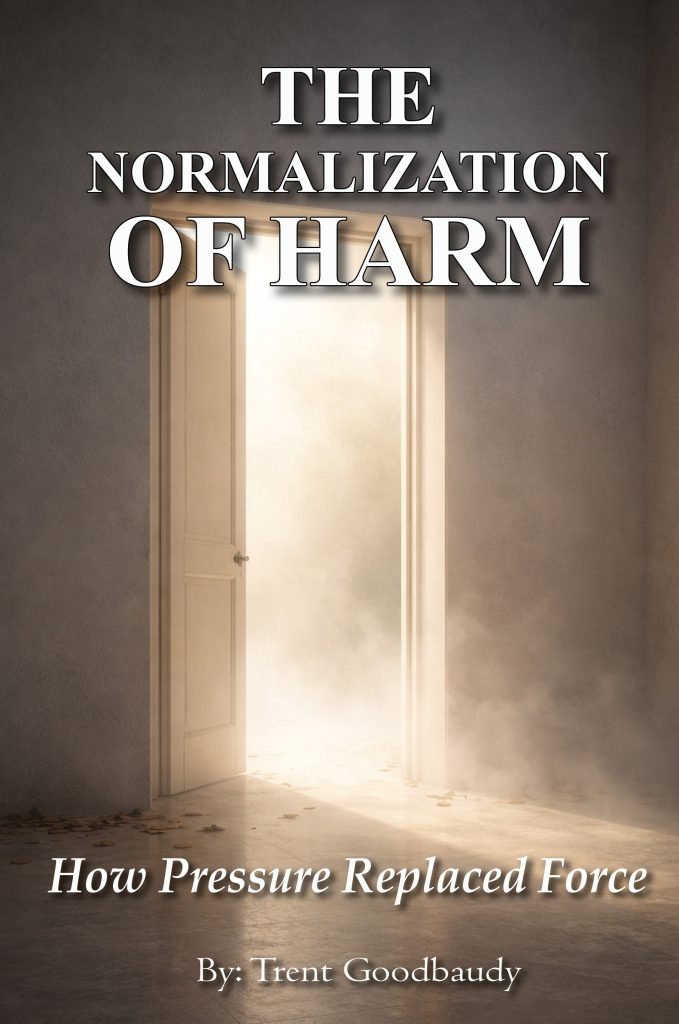
The Normalization of Harm was written to examine what happens when harm is no longer imposed through force, punishment, or explicit authority — but instead managed through coordination, tone, care, and internalized responsibility. Harm reduction is one of the clearest places where this shift can be observed.
Not because harm reduction is malicious.
But because it often operates without asking what kind of harm is being reduced — and at what cost.
When harm becomes ambient
Traditional harm was visible.
It had a source.
It had a moment.
It had an aftermath.
Modern harm often doesn’t.
It arrives gradually, through policies, metrics, norms, and expectations that no single person authors and no single moment announces. Instead of force, it relies on pressure — the quiet kind that asks people to adapt rather than comply.
Harm reduction fits naturally inside this landscape.
By focusing on minimizing immediate damage, systems can avoid addressing deeper structural questions. Harm becomes something to be managed, not confronted. People are trained to accept tradeoffs quietly, to accommodate conditions incrementally, and to internalize responsibility for outcomes they did not design.
Nothing dramatic happens.
And because nothing dramatic happens, nothing feels wrong enough to challenge.
Pressure replaces force
One of the central observations in The Normalization of Harm is that modern systems rarely need to coerce. They coordinate instead.
They don’t command obedience.
They encourage alignment.
They don’t threaten punishment.
They imply reasonableness.
Harm reduction often functions within this logic.
Rather than asking whether a system itself produces harm, attention shifts to whether individuals are managing their exposure responsibly. Risk becomes personal. Adaptation becomes virtuous. Dissent becomes unnecessary.
This does not require bad actors.
It requires careful people — people who want to be reasonable, compassionate, and cooperative.
And so harm is reduced in one dimension while quietly expanded in another.
The quiet cost of being reasonable
Harm reduction frameworks tend to reward smoothness.
Less disruption.
Less conflict.
Less resistance.
Over time, this produces a subtle narrowing:
- Emotional responses are softened.
- Language becomes cautious.
- Creativity is filtered.
- Relationships flatten.
- Self-monitoring increases.
None of this registers as trauma.
In fact, it often feels like maturity.
People adapt.
People function.
People survive.
But adaptation has a cost when it becomes permanent — especially when no one is allowed to name it.
This is the kind of harm The Normalization of Harm is concerned with:
not injury, but diminishment;
not violence, but quiet erosion;
not catastrophe, but accumulation.
Why naming harm matters
Harm that remains unnamed continues to operate.
When harm is reframed exclusively as something to be reduced, managed, or mitigated, it becomes difficult to ask more fundamental questions:
What is being normalized?
Who is being asked to adapt?
What capacities are quietly shrinking?
What forms of life are becoming unavailable?
The Normalization of Harm does not argue against harm reduction as a moral impulse. It examines harm reduction as a structural pattern — one that can unintentionally obscure long-term cost by prioritizing short-term stability.
This book does not offer solutions.
It does not propose reforms.
It does not tell readers what to believe.
It simply maps how harm changes shape when pressure replaces force — and what happens to people when harm becomes something they are expected to manage internally.
A book without urgency
This book was written quietly, on purpose.
There is no call to action.
No demand for agreement.
No instruction to resist or reform.
The absence of pressure is not accidental. It mirrors the argument.
Readers are not asked to change their lives. They are invited to notice patterns they may already recognize — patterns that often go unnamed because they do not announce themselves loudly enough to justify concern.
If something resonates, it does so without urgency.
If nothing does, nothing is lost.
This posture is deliberate.
Because the most effective pressure is the kind that feels like common sense — and the most enduring clarity is the kind that does not require persuasion.
About LibertyTruth.org
LibertyTruth.org exists to examine how modern systems shape behavior without overt force — through language, incentives, norms, tone, and internalized regulation.
It is not a movement.
It is not an ideology.
It does not seek consensus.
The books published under LibertyTruth.org are designed to restore orientation rather than impose conclusions — offering language for experiences many people feel but struggle to name.
The Normalization of Harm is one part of a larger body of work exploring authority, adaptation, and the quiet mechanics of modern life — including an upcoming companion volume, Deferred Authority, which examines what happens when responsibility is endlessly postponed rather than imposed.
The only invitation LibertyTruth.org extends is attention.
What readers do with that attention remains their choice — quietly, deliberately, and without pressure.