Author: Libertyman

  • The Limits of Feel-Good Emotional Intelligence

    The Limits of Feel-Good Emotional Intelligence

    A Quiet Line in the Sand

    Over the last few decades, “emotional intelligence” has become a cultural banner. It appears in leadership seminars, therapy offices, corporate trainings, social media clips, and bestselling books. It promises awareness, empathy, self-regulation, and better outcomes—at work, in relationships, and in life.

    And for many people, it does offer an entry point.

    But entry points are not destinations.

    At LibertyTruth.org, we are not trying to improve the emotional-intelligence conversation. We are not refining it, modernizing it, or repackaging it with better language. We are addressing something more foundational—something that much of popular psychology quietly avoids.

    This work begins where feel-good frameworks stop working.


    The Emotional Intelligence Industry: What It Gets Right—and Where It Fails

    Let’s be precise and fair.

    Mainstream emotional-intelligence frameworks have contributed real value:

    • They helped normalize emotional awareness.
    • They pushed back against repression and emotional illiteracy.
    • They encouraged empathy and interpersonal sensitivity.
    • They gave language to experiences people previously lacked words for.

    But over time, something subtle happened.

    Emotional intelligence became emotional management.
    Then emotional management became emotional performance.
    And emotional performance slowly turned into emotional identity.

    Today, much of the field operates on unspoken assumptions:

    • That emotions must be expressed to be processed
    • That discomfort must be resolved to be healthy
    • That validation equals healing
    • That clarity comes from talking things through
    • That regulation means calming or reframing feelings

    These assumptions sound benign. Often they are comforting.

    They are also incomplete.


    Where Popular Psychology Quietly Breaks Down

    Liberty Truth exists because many people reach a point where the standard tools no longer help—and no one explains why.

    Common experiences we hear from readers:

    • “I understand my emotions, but I still feel stuck.”
    • “I can name what I’m feeling, but it doesn’t change anything.”
    • “I’ve done the work, but something still feels off.”
    • “I’m calm, but not clear.”
    • “I’m regulated, but not grounded.”

    These are not failures of effort.
    They are failures of framework.

    Most popular emotional-intelligence models focus on content:

    • What you feel
    • Why you feel it
    • How to express it
    • How to manage it

    Liberty Truth focuses on structure:

    • How internal signals organize before emotion
    • How pressure accumulates before feeling labels appear
    • How identity interferes with perception
    • How reaction happens before thought
    • How stillness reveals information that expression cannot

    This is not a therapeutic stance.
    It is an observational one.


    Liberty Truth Is Not About Feeling Better

    This is a crucial distinction.

    Liberty Truth does not promise relief, comfort, catharsis, or emotional payoff.
    It does not offer affirmations, reframes, or motivational arcs.
    It does not aim to make readers feel understood.

    Instead, it aims to make readers accurate.

    Accuracy is quieter than validation.
    Accuracy is less flattering than encouragement.
    Accuracy does not rush to resolve tension.

    But accuracy stabilizes.

    Many Liberty Truth books intentionally avoid:

    • Step-by-step methods
    • Exercises
    • Techniques
    • “Try this” instructions
    • Prescriptive conclusions

    This is not omission—it is design.

    Because instruction often becomes interference.


    The Central Premise Most Frameworks Miss

    There is a premise that quietly governs the Liberty Truth body of work:

    Many internal problems are not caused by emotion itself,
    but by intervening too early in the signal.

    Popular emotional-intelligence approaches often teach people to:

    • Interpret quickly
    • Respond thoughtfully
    • Regulate actively
    • Reframe promptly

    But what if clarity does not come from response at all?

    What if:

    • Stillness precedes insight
    • Non-reaction reveals structure
    • Waiting is not avoidance
    • Silence is not suppression
    • Neutrality is not numbness

    Liberty Truth examines what happens before emotion becomes narrative—and what happens when nothing is done too soon.


    Why This Work Feels “Different” to Readers

    Readers often struggle to categorize Liberty Truth books because they don’t behave like typical psychology texts.

    Common reactions include:

    • “This doesn’t tell me what to do.”
    • “Nothing is being explained, but I see more.”
    • “I feel steadier, not motivated.”
    • “This is unsettling, but clarifying.”
    • “It removed something instead of adding something.”

    That is intentional.

    The work is subtractive.
    It removes urgency.
    It removes performance.
    It removes emotional theatrics.
    It removes identity overlays.

    What remains is signal integrity.


    Addressing the Feel-Good Framework Directly

    To those steeped in affirmation-based, validation-forward, empowerment-language psychology:

    Liberty Truth is not here to invalidate your experience.
    But it will challenge the idea that:

    • Emotional expression equals processing
    • Feeling seen equals being clear
    • Talking equals resolving
    • Comfort equals health

    It asks a harder question:

    What if some clarity only appears when you stop managing yourself?

    This question can feel threatening in a culture built on expression.
    But it is often liberating to those who have already expressed everything—and still feel constrained.


    Why Liberty Truth Exists as a Platform, Not a Single Book

    This work cannot live comfortably inside a single title.

    Each book examines a different failure point of modern self-understanding:

    • Where insight turns into self-monitoring
    • Where regulation turns into control
    • Where awareness turns into fixation
    • Where empathy turns into self-abandonment
    • Where calm turns into passivity

    Together, they form a counter-library—not against psychology, but against its unexamined assumptions.

    LibertyTruth.org exists to house that library without dilution.

    No algorithms demanding optimism.
    No trend cycles demanding relatability.
    No pressure to reassure.


    Who This Work Is For

    This work is not for everyone.

    It resonates most with people who:

    • Have already done years of inner work
    • Feel constrained by therapeutic language
    • Sense that something precedes emotion
    • Are no longer seeking motivation
    • Value clarity over comfort
    • Are willing to sit with unresolved knowing

    If you are looking to feel better quickly, this is not the place.

    If you are looking to see more accurately, it may be.


    A Closing Distinction

    Popular emotional intelligence asks:

    “How do I feel, and what should I do with it?”

    Liberty Truth asks:

    “What is already registering—before I interfere?”

    That difference may seem subtle.
    It is not.

    It is the difference between managing experience
    and standing still long enough to understand it.

    Be sure to check out our library!

    OR OUR AMAZON AUTHOR PAGE!

  • You’re Not Crazy. You’re Being Conditioned.

    You’re Not Crazy. You’re Being Conditioned.

    If it feels like the world is louder, dumber, angrier, and more exhausting than it used to be — that’s not an accident.

    You are living inside a constant influence environment.

    Not just politics.
    Not just media.
    Not just algorithms.

    Everything.

    Your attention is being pulled.
    Your emotions are being triggered.
    Your thinking is being steered.

    And the most dangerous part?
    Most of it doesn’t feel like control at all.

    It feels like normal life.


    The Real Problem Isn’t Lies — It’s Agreements

    Modern manipulation doesn’t rely on convincing you of something new.

    It works by getting you to quietly agree to things you never consciously chose:

    • What matters
    • What’s “acceptable” to question
    • What’s off-limits
    • Who you’re allowed to be

    Once those agreements are in place, the system doesn’t need force.
    You self-regulate. You self-censor. You self-police.

    That’s the trap.

    And most people never see it — because they’ve been trained not to look.


    Why Awareness Alone Isn’t Enough

    A lot of people sense that something is wrong.

    They consume documentaries.
    They scroll “truth” content.
    They collect outrage.

    But they still feel stuck.

    Why?

    Because seeing manipulation isn’t the same as being free from it.

    If you don’t know where your thinking has been shaped, you’ll keep reacting instead of choosing.
    If you don’t know how influence works, you’ll keep mistaking pressure for reality.

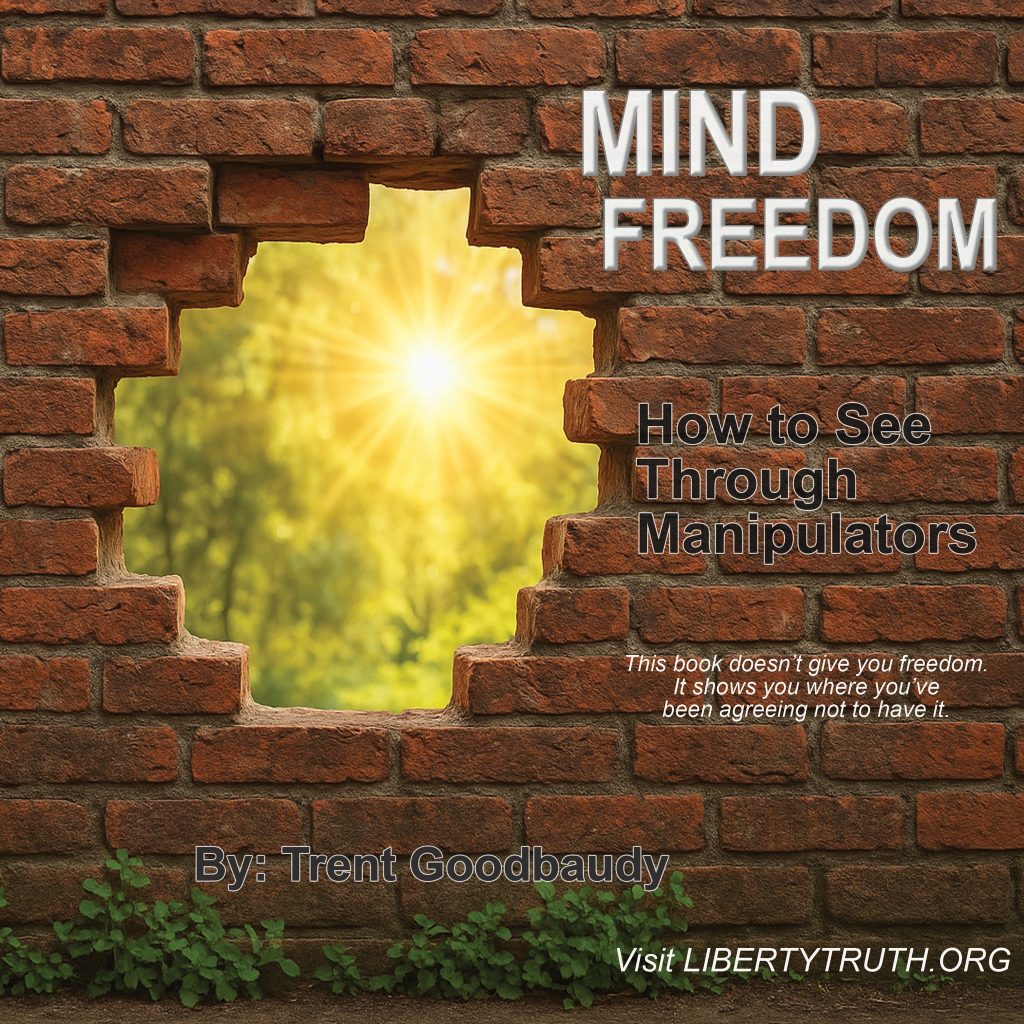
    That’s where Mind Freedom comes in.


    What Mind Freedom Actually Does

    This book doesn’t tell you what to think.

    It shows you where you’ve been agreeing not to think.

    It breaks down:

    • How psychological pressure is applied without force
    • Why guilt, fear, and identity are such powerful levers
    • How authority gets internalized — and defended
    • Why “going along” feels safer than standing still

    More importantly, it helps you locate your own mind again.

    Not through rebellion.
    Not through ideology.
    Through clarity.


    This Isn’t Self-Help. It’s Self-Recovery.

    A free society doesn’t collapse all at once.

    It erodes when individuals lose:

    • Internal authority
    • Discernment
    • The ability to say “no” without anger
    • The courage to think without permission

    Mind Freedom is about restoring that foundation — one person at a time.

    Because a country cannot be free if its people are mentally outsourced.

    And a life cannot be rebuilt if the mind running it isn’t truly yours.


    Read It If You’re Ready to Be Honest

    This book isn’t for people looking to feel validated.

    It’s for people who are willing to ask:

    • “Where did this belief come from?”
    • “Why does this emotion get triggered so easily?”
    • “What have I been agreeing to without realizing it?”

    If you’ve felt the pressure.
    If you’ve felt the exhaustion.
    If you’ve felt like the rules keep changing but no one can explain why.

    You don’t need more information.

    You need Mind Freedom.

    Not to escape the world —
    but to re-enter it on your own terms.

    Get the books here.

  • A Quick Update From Liberty Truth (Yes, A Lot Happened)

    A Quick Update From Liberty Truth (Yes, A Lot Happened)


    If it feels like things have been unusually quiet around here the past couple of days, that’s because we’ve been busy doing something slightly unhinged (but in a good way).

    Now Available on Amazon.com
    Now Available on Amazon.com
    Now Available on Amazon.com

    In short: we just published three books.
    And we’re getting ready to publish a fourth.

    Which is one of those sentences that sounds normal until you say it out loud and then go,
    “Oh… wow. Okay. That actually happened.”

    What We’ve Been Building

    The last few days have mostly been about laying a foundation.

    The books are a big part of that. They’re not random projects — they’re meant to work together. They’re the baseline ideas, the “start here” material for what Liberty Truth is becoming next.

    At the same time, we’ve been building out a new website where:

    • All of the books will live in one place
    • An online store will be coming together
    • Other products and merchandise will start showing up
    • And everything won’t feel scattered across the internet anymore

    Think of it as moving from “ideas in motion” to “a home base.”

    And Yes, There’s More Coming

    We’re also gearing up to bring new YouTube videos back into the mix. Not noise. Not hype. Just clear, grounded content that fits the same lane as the books.

    If this feels familiar, that’s not an accident.

    Some of you might remember the old Freedom From Government days. Liberty Truth is carrying forward that same independent spirit — but with sharper focus, better tools, and a lot more lived experience behind it.

    Less reaction.
    More clarity.
    Less fighting shadows.
    More building something solid.

    Why We’re Sharing This Now

    We could’ve waited until everything was perfectly polished.

    But that’s not how this works — and honestly, that’s not who we are.

    We wanted to loop you in while things are still being assembled, while the shelves are still getting installed, while the ink on the pages is still drying.

    You’re not showing up late.
    You’re showing up right on time.

    The Road Ahead

    There’s more coming.
    The store will grow.
    The library will expand.
    The conversations will deepen.

    But for now, this is just us saying:

    “Hey — this is real now. And we’re glad you’re here.”

    More soon.
    Probably sooner than planned.
    Definitely without pretending this all appeared overnight.

    Liberty Truth

  • Before You Read the Liberty Trilogy: A Message to Prepare You

    Most books entertain you.
    Some books inform you.
    A few books challenge you.

    These three books—the Liberty Trilogy—will change the way you think, relate, lead, and act in ways you may not expect.

    This article is to prepare you.

    Not because the material is difficult, but because it is disruptive.
    Not because it is heavy, but because it is clarifying.
    Not because it demands obedience, but because it will ask you to stop giving it.

    You are about to walk into a framework that can’t be unread, unseen, or undone.


    Before the Trilogy, Most People Feel This

    You’ve probably felt it already:

    • Something in conversations that doesn’t add up
    • A subtle pressure to doubt yourself
    • A sense that your clarity flickers in certain environments
    • A desire to stand firm—but hesitation at the moment of action

    Nothing is “wrong” with you.
    You were conditioned to feel this way.

    The Liberty Trilogy doesn’t shame you for that.
    It simply shows you the architecture underneath it.


    **Book 1 will change what you notice.

    Book 2 will change how you stand.
    Book 3 will change how you move.**

    And because of that, something important needs to be said up front:

    This trilogy will challenge your reflexes, not your intelligence.

    These books won’t just teach you new ideas; they’ll reveal patterns you’ve been living inside without awareness. You may recognize yourself in ways that are uncomfortable—but clarifying.

    The goal isn’t to destabilize you.

    The goal is to free the part of you that has been overpowered, outsourced, or silenced.


    What These Books Are Actually Doing

    1. They dismantle false influence.

    You will shed beliefs and reflexes you never consciously chose.
    You will see pressure points you once fell for without noticing.

    2. They rebuild internal authority.

    You will reclaim self-trust, decision-making, and discernment.
    Not confidence—authority.

    3. They redefine power entirely.

    You will learn how to act without force, urgency, guilt, or control.
    This is rare.
    This is needed.
    This is liberating in a way most people have never experienced.


    You May Experience Three Reactions While Reading

    1. Recognition

    “What I’ve been feeling finally makes sense.”

    This is the relief stage.
    Your intuition gets language.
    Fog lifts.

    2. Confrontation

    “Oh… this is where I drift into manipulation/control/avoidance.”

    This is the maturity stage.
    You meet yourself clearly.
    No shame—just accountability.

    3. Realignment

    “I can do this differently now.”

    This is the empowerment stage.
    Your inner and outer worlds start matching.
    You move cleanly.

    Most readers cycle through these three more than once.


    Prepare to See Differently

    After Mind Freedom, you won’t be able to un-see the tactics people use:

    • Guilt disguised as care
    • Urgency disguised as importance
    • Confusion disguised as authority
    • Passivity disguised as humility
    • Kindness used as leverage

    It isn’t paranoia.
    It’s pattern recognition.

    Your perception sharpens—not into judgment, but into clarity.


    Prepare to Stand Differently

    After Inner Authority, you will:

    • Stop asking for permission
    • Stop explaining boundaries
    • Stop outsourcing discernment
    • Stop collapsing into guilt
    • Stop fearing disagreement

    Your posture changes.
    Your decisions get cleaner.
    Your relationships stabilize.

    People around you notice—because clarity is contagious.


    Prepare to Act Differently

    After Clean Power, you will:

    • Intervene less—but more precisely
    • Speak less—but more effectively
    • Lead without micromanaging
    • Influence without manipulating
    • Protect without restricting
    • Move without ego

    This is power you can trust.
    This is power others feel safe around.

    And it will surprise you how quickly this becomes your new baseline.


    This Trilogy Is Not About Becoming Harder

    It is about becoming clearer.

    Not reactive.
    Not withdrawn.
    Not performative.

    Clear.

    Clarity makes you strong in a way that doesn’t need to be loud.


    Who You Become After Reading the Trilogy

    Someone who:

    • Sees through distortion instantly
    • Makes decisions without wobble
    • Acts without leaving damage
    • Leads without control
    • Walks away without guilt
    • Speaks without overexplaining
    • Remains grounded even when others aren’t

    Someone whose presence stabilizes rooms.

    Someone who cannot be manipulated without noticing.

    Someone who carries power without needing recognition.


    The Mental Shift to Make Before Reading

    Let go of two assumptions:

    1. “I already see things clearly.”
      You’ll discover blind spots—everyone has them.
      That’s the point.
    2. “These books will tell me what to do.”
      They won’t.
      They give you back the ability to decide for yourself.

    Approach the trilogy with openness—not submission.
    You are not being taught what to think.
    You are being shown how to reclaim what was always yours.


    Get Ready for a Before-and-After Moment

    This isn’t a motivational series.
    This isn’t a self-help trend.
    This isn’t a leadership hack or a confidence trick.

    This is a rewiring of how you relate to influence, authority, and power—inside yourself and in the world around you.

    Most people spend their whole lives reacting.

    These books teach you how to govern yourself—and lead without corruption.

    If you’re ready to see clearly, stand firmly, and act cleanly…

    The Liberty Trilogy is going to feel like a return to yourself.

  • 🚘 I Used to Be Terrified of Getting Pulled Over — Until I Learned This One Truth

    🚘 I Used to Be Terrified of Getting Pulled Over — Until I Learned This One Truth

    By: Trent Goodbaudy | LibertyTruth.org

    Let me be honest with you.

    There was a time when I couldn’t relax behind the wheel.
    Even when everything was in order — insurance, registration, taillights all working — I’d still feel it:

    That tight grip in my chest…
    That internal “what if”…

    And then the flash of red and blue lights.
    A minor thing. A plate light. A tag. A “routine stop.”

    But it didn’t feel routine.
    It felt like being put on trial — without a courtroom.


    😰 Fear Isn’t Freedom

    It’s strange, right?

    We grow up in a country that teaches us we’re free…
    Yet we’re afraid to ask basic questions, like:

    “Why was I pulled over?”

    “Am I required to answer that?”

    “Is this a consensual conversation?”

    We’re told that asking those things is confrontational — that we’ll make it worse for ourselves.

    But here’s what I finally realized: it’s not your tone that creates tension — it’s their assumption of your submission.


    🧠 One Shift Changed Everything: I Stopped Playing Defense

    I used to drive expecting to be stopped.
    Now, I drive expecting to be respected — because I carry myself like someone who understands where the line is.

    Not someone looking for a fight.
    Not someone acting like I’m above the law.
    But someone who has learned:

    ⚖️ The law protects the informed. The system pressures the uninformed.


    🧰 Here’s What Changed the Game For Me

    I didn’t go down a rabbit hole. I didn’t memorize obscure codes.

    I just learned three basic pillars:

    1. You’re not obligated to make their job easier — only to remain peaceful.

    You’re not required to volunteer information. You’re not required to consent to a search.
    You are required to stay calm, still, and respectful.

    1. Most “consensual” interactions only happen because people don’t say no.

    The question isn’t whether the cop is doing their job — it’s whether you’re unknowingly waiving your rights.

    1. Your composure is your credibility.

    Righteousness is silent. Let your posture, your tone, and your choice of words speak for you.


    🚨 The Real Cost of Ignorance

    I’ve seen people charged with obstruction — not because they were aggressive, but because they panicked.

    I’ve seen people arrested after a dog “alerted” — when nothing was found — because they agreed to a search thinking “I have nothing to hide.”

    The system doesn’t always need guilt. It just needs permission.

    Let that sink in.


    🌱 You Don’t Have to Live This Way

    You don’t have to ride around on edge.
    You don’t have to film every interaction while yelling about the Constitution.
    You just need to be trained in your rights like you would be trained in CPR.

    Simple. Practical. Calm. Effective.


    ✊ That’s What LibertyTruth Is All About

    We’re building something different here.

    Not another “sovereign citizen” echo chamber.
    Not another rage-filled “they work for us” soapbox.

    Just real tools for real people who want to reclaim their peace — legally, safely, and without self-sabotage.

    We’ve got:

    Printable Exercise Your Rights cards

    Rights Guides you can actually understand

    Blog stories and tips from real encounters on the road

    And soon: gear, downloads, and training that travels with you


    🧭 Final Thought: The More You Know, the Less You Fear

    Knowledge isn’t just power — it’s peace.

    And when you stop being afraid of the stop,
    You start traveling like a free person again.

    So keep your head up.
    Keep learning.
    And never forget:

    🚦Your freedom isn’t granted by the system. It’s protected when you learn how to walk through it wisely.


    📬 Join our free weekly newsletter for more articles like this, plus field-tested tools for staying calm, legal, and free — even in the age of the overstep.

  • Power, Fear, and Perception: The Psychology Behind Police Encounters (And How to Keep Your Ground)

    By a Licensed Psychotherapist | LibertyTruth.org

    When you’re pulled over or approached by law enforcement, something deeper is happening than what you see on the surface. There’s a rapid and often unconscious interplay of psychology unfolding — for both the officer and the civilian. Understanding this dynamic can be the difference between escalation and resolution, panic and peace, fear and freedom.

    In this article, we’ll take a clinical yet practical look at the psychological states of both parties, and how you, as a conscious citizen, can navigate the situation without losing your center — or your rights.


    The Officer’s Psychology: Trained Authority Under Stress

    Let’s begin with the police officer. It’s critical to understand that most law enforcement officers are trained with a “command and control” mindset.

    This means:
    1. Hypervigilance and Threat Perception

    Officers are often in a state of hyper-awareness, trained to see potential threats in every unknown — from a concealed hand to a hesitant response. This is a psychological state akin to chronic sympathetic nervous system activation (fight or flight). Their brains are scanning for danger cues, and sometimes, innocuous behavior may be misinterpreted as suspicious.

    2. Authoritarian Conditioning

    Through both academy training and on-the-job exposure, officers are conditioned to assert control immediately in any interaction. Compliance is expected — not requested. This conditioning can sometimes override personal empathy or discretion. The psychology here is defensive: if they lose control, they feel at risk.

    3. Us vs. Them Paradigm

    Repeated exposure to danger can lead to a subtle but powerful mental bias called “moral disengagement” — officers may unconsciously divide the world into allies (other officers) and adversaries (everyone else). This separation can result in an emotionally detached or even suspicious demeanor, especially when a civilian questions their authority.


    The Civilian’s Psychology: Intimidation, Confusion, and Freeze Response

    Now let’s examine what’s happening on your side of the equation.

    1. Sudden Authority Shock
    When lights flash in your rearview mirror or a uniformed officer approaches you, it can trigger an immediate adrenaline spike. This isn’t weakness — it’s biology. Your body is reacting to a perceived loss of control and potential danger, even if you’ve done nothing wrong. This can result in a “freeze” response, where your memory, verbal skills, and rational thinking all momentarily drop.

    2. Powerlessness and Induced Submission
    Police encounters are structured — often deliberately — to reinforce a power differential. The officer stands while you sit. He asks the questions, you answer. You’re often separated from your environment, made to feel watched, recorded, and vulnerable. These elements combine to create a psychological pressure that compels compliance through intimidation, not logic.

    3. Gaslighting and Emotional Dysregulation

    If an officer gives conflicting commands or shifts tone suddenly — e.g., from calm to aggressive — this may trigger confusion and self-doubt. This is often not intentional, but it has a gaslighting effect, where you may begin to second-guess your rights or your memory of events. This erodes your confidence and makes you easier to dominate psychologically.


    The Goal of Understanding: Regain Your Center

    The key to protecting your rights — and your mental well-being — during a police encounter is not confrontation, but conscious self-regulation.

    Here’s how:

    🔹 1. Master Your Own Nervous System

    Breathe deeply. Ground your body. Keep your tone and body language calm. Officers are trained to escalate based on perceived resistance or erratic behavior. By appearing non-threatening yet assertive, you’re shifting the psychological dynamic back toward neutrality.

    Try this: Before speaking, take a slow 4-count inhale and 4-count exhale. This centers your nervous system and buys your brain precious milliseconds to respond thoughtfully

    🔹 2. Use Calm Assertiveness, Not Combativeness

    Instead of saying “I know my rights!” with a defiant tone, say:> “Officer, I’d like to exercise my right to remain silent. I don’t consent to any searches.”It’s the same message — but without the psychological trigger that can cause the officer to feel challenged or disrespected.

    🔹 3. Name the Behavior (Silently, To Yourself)

    If an officer raises their voice, looms over you, or tries to confuse you with conflicting orders, mentally label the tactic without reacting:> “He’s trying to provoke fear.”“This is meant to unnerve me.”Naming it to yourself removes its power over you. You become the observer of the tactic, not the victim of it.

    🔹 4. Know Your Script Before You Need It

    Have a mental (or written) script ready for police encounters. Rehearse it. Just as officers have muscle memory from training, you need response memory from practice. This reinforces confidence and keeps fear at bay.

    Final Thoughts: It’s Not You vs. Them

    This isn’t about waging war on law enforcement. It’s about inner sovereignty, not legal rebellion. Officers are often just trying to get through the day safely. But you also have the right to get home safely with your dignity, privacy, and liberty intact.Knowing the psychology of both sides allows you to rise above the emotional games — and stand calmly in your rights


    🧠 Stay grounded. Stay free. Stay aware.📚 For tools, scripts, and printable guides, visit [LibertyTruth.org/resources].